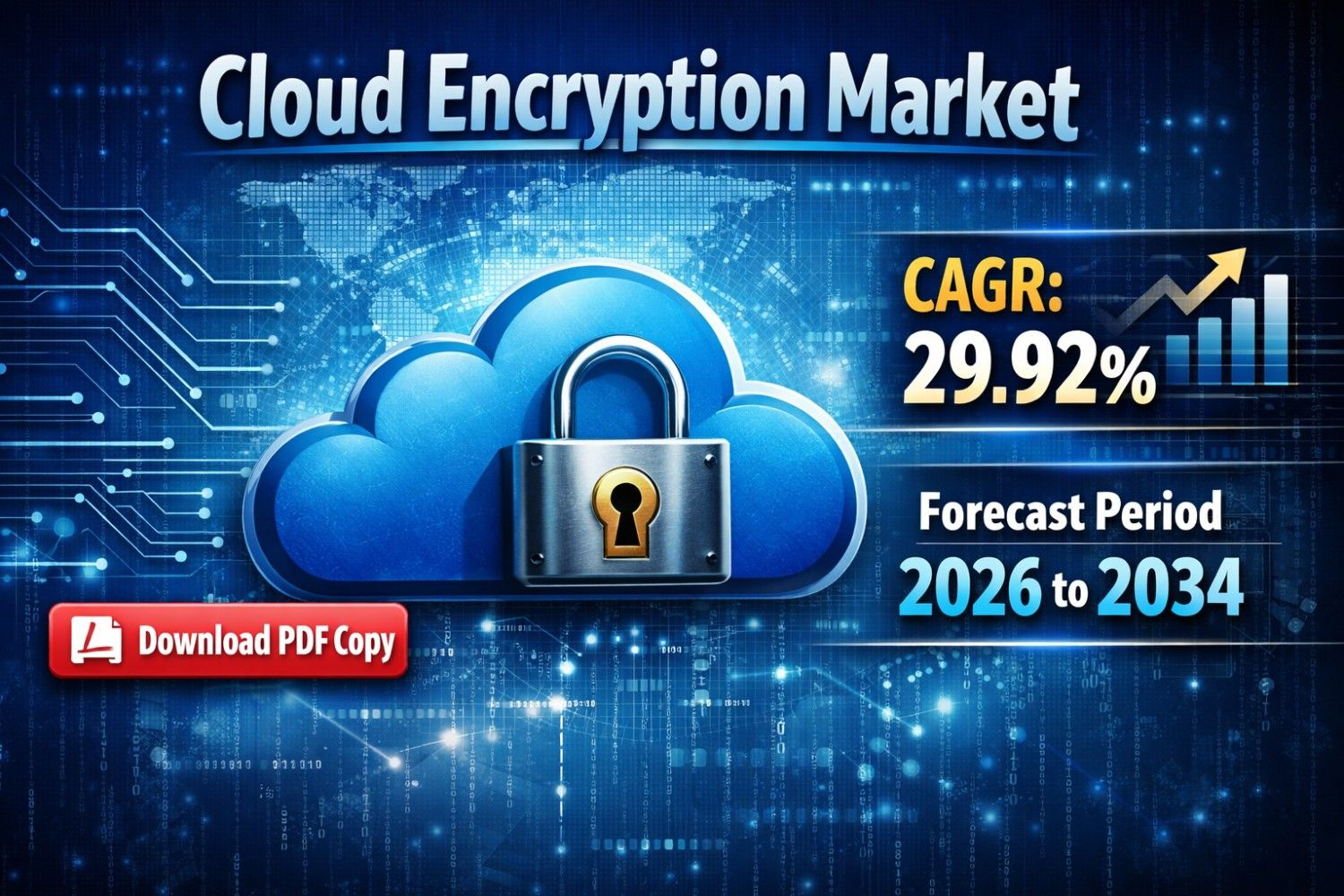
The global cloud encryption market is undergoing a profound transformation as organizations move beyond basic data protection to adopt sophisticated security frameworks. As of 2026, the industry is witnessing a shift from perimeter-based defense to data-centric security models, where encryption is integrated into every layer of the cloud computing stack. With the market projected to reach significant valuations by 2034, the focus has moved toward automation, quantum resilience, and seamless multi-cloud interoperability.
Cloud Encryption market size is expected to reach US$ 64.24 Billion by 2034 from US$ 6.09 Billion in 2025. The market is anticipated to register a CAGR of 29.92% during the forecast period 2026–2034.
Recent Industry Developments
The landscape of cloud encryption is defined by rapid technological advancements and strategic corporate shifts aimed at mitigating the evolving threat environment.
Advancements in Quantum-Safe Cryptography
Leading technology providers have intensified their efforts to develop quantum-resistant algorithms. Recent months have seen major cloud providers, including IBM and Microsoft, actively testing and deploying post-quantum cryptographic standards. This development is crucial as enterprises prepare for the eventual realization of practical quantum computing, which threatens to render traditional RSA and ECC encryption obsolete.
AI-Driven Automated Key Management
One of the most significant trends in 2026 is the integration of Artificial Intelligence into Key Management Systems (KMS). Automated key rotation and lifecycle management have become standard features for major platforms. These AI-driven tools reduce human error by automatically managing cryptographic keys across complex, multi-cloud environments, ensuring that security policies remain consistent regardless of the underlying cloud provider.
Growth of Confidential Computing
The industry is experiencing a surge in the adoption of confidential computing, which utilizes hardware-based Trusted Execution Environments (TEEs). By encrypting data in use specifically when it is being processed in memory companies like Intel and various cloud giants are closing the final gap in end-to-end data protection. This shift allows highly regulated industries such as finance and healthcare to perform sensitive data analytics without ever exposing raw information to the cloud host.
Expansion of Encryption-as-a-Service (EaaS)
The shift toward Encryption-as-a-Service is democratizing high-level security for small and medium enterprises. Recent service launches, such as user-friendly file encryption management solutions, enable organizations to apply client-side encryption across distributed cloud storage environments with minimal configuration. This lowers the barrier to entry for robust security, driving widespread adoption across diverse verticals.
Download Sample PDF Report@ https://www.theinsightpartners.com/sample/TIPTE100002174
Key Industry Players
The market is currently characterized by intense competition and strategic collaboration among established technology leaders. These players are focusing on expanding their security portfolios through R&D and aggressive acquisition strategies.
- IBM Corporation
- Thales Group
- Microsoft Corporation
- Google LLC
- Broadcom (Symantec)
- Cisco Systems, Inc.
- Intel Corporation
- Sophos Ltd.
- Check Point Software Technologies
- Dell Technologies
These organizations are not only providing standalone encryption software but are also embedding cryptographic capabilities directly into networking hardware, cloud operating systems, and developer toolkits to ensure pervasive security.
Future Outlook
The trajectory for the cloud encryption market through 2034 suggests a transition into an era of autonomous security. We expect to see the widespread implementation of Fully Homomorphic Encryption, which will allow data to remain encrypted even while it is being computed. This technology will fundamentally change data privacy standards, as it enables deep analysis of sensitive datasets without requiring decryption at any point in the workflow.
Furthermore, as cloud infrastructure continues to decentralize, encryption will become the primary mechanism for establishing digital trust at the edge. The future market will likely prioritize "Encryption-as-code," where security protocols are automatically provisioned as part of the software development lifecycle. This integration will make robust data protection an inherent property of digital infrastructure, effectively future-proofing organizations against the next generation of cyber threats.
Frequently Asked Questions
What is the significance of encryption in use for cloud security?
Encryption in use protects data while it is actively being processed by a CPU or stored in system memory. While data at rest and in transit are relatively mature, encryption in use addresses the remaining vulnerability where data is briefly exposed during computation, making it vital for secure cloud analytics.
How do recent AI developments affect key management?
AI enhances key management by providing predictive monitoring and automated lifecycle management. It can identify patterns in key access, detect potential anomalies or unauthorized attempts to retrieve keys, and automate the rotation of keys to prevent them from being compromised over long periods.
What is the impact of quantum computing on current cloud encryption?
Quantum computing poses a long-term threat to current asymmetric encryption standards. Recent developments are focusing on transitioning to quantum-resistant algorithms that can withstand the processing power of future quantum machines. Organizations are already moving toward crypto-agility to swap out vulnerable algorithms for quantum-safe alternatives.
About The Insight Partners
The Insight Partners provides comprehensive syndicated and tailored market research services in the healthcare, technology, and industrial domains. Renowned for delivering strategic intelligence and practical insights, the firm empowers businesses to remain competitive in ever-evolving global markets.
Contact Information
- Email: [email protected]
- Website: theinsightpartners.com
- Phone: +1-646-491-9876
Also Available in: Korean|German|Japanese|French|Chinese|Italian|Spanish