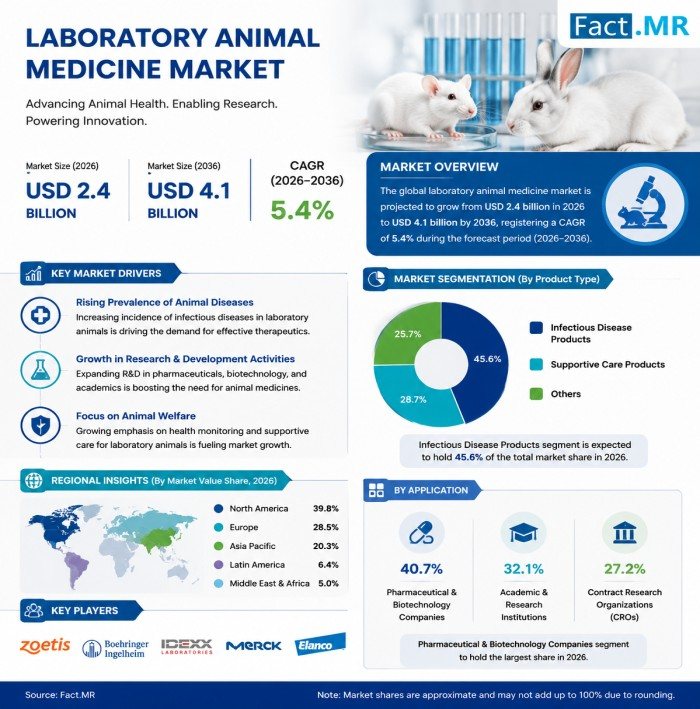
ROCKVILLE, MARYLAND , August 4, 2026 — The global laboratory animal medicine market crossed a valuation of USD 4.6 billion in 2025 and is projected to increase from USD 4.9 billion in 2026 to USD 9.0 billion by 2036, expanding at a compound annual growth rate (CAGR) of 6.3% over the forecast period. According to a research report published by Fact.MR (Report ID: FACT15856MR), the market represents an absolute dollar opportunity of USD 4.4 billion over the 10-year period, driven by institutional demand for study reproducibility, welfare compliance, and auditable supplier quality files.
Get detailed market forecasts, competitive benchmarking, and pricing trends: https://www.factmr.com/connectus/sample?flag=S&rep_id=15856
Key Market Findings
- Market Valuation: Valued at USD 4.6 billion in 2025; reaching USD 4.9 billion in 2026 and USD 9.0 billion by 2036.
- Forecast CAGR: 6.3% annually from 2026 through 2036.
- Absolute Opportunity: USD 4.4 billion cumulative revenue expansion between 2026 and 2036.
- Leading Product Segment: Pharmaceuticals hold a 34.0% market share in 2026.
- Leading Application: Biomedical Research commands a 36.0% market share in 2026.
- Leading End User: Pharmaceutical & Biotechnology Companies account for a 39.0% market share in 2026.
- Fastest-Growing Country: Germany leads national growth with a 7.2% CAGR through 2036.
Primary Growth Drivers
Research sponsors and preclinical facilities are shifting procurement from basic housing supplies toward controlled veterinary inputs. Key drivers accelerating market adoption include:
- Study Reliability and Reduction of Biological Variation:Infection, uncontrolled pain, dietary inconsistency, and unstandardized monitoring introduce experimental noise, forcing study exclusions and delaying development decisions. Protocol-linked veterinary inputs reduce avoidable noise in in vivo trials.
- Recurring Protocol-Linked Replenishment:Anesthetics, anti-infectives, vaccines, diagnostics, standardized diets, and surgical consumables are embedded into approved ethical protocols. Replenishment continues per procedure or treatment course even when overall animal usage volumes fluctuate.
- Traceability and Auditability Demands:Laboratory animal veterinarians and facility managers require species-specific quality documentation, lot traceability, and defined storage parameters to maintain approved welfare standards without disrupting trial continuity.
Comprehensive Segment Analysis
Product Type Breakdown
- Pharmaceuticals (34.0% Share in 2026): Represents the largest product segment. Demand is generated through repeatable protocol administration of anesthetics during surgical procedures, anti-infective treatments for colony health management, and preventive vaccination programs.
- Supportive Consumables, Diagnostics, and Equipment: Includes molecular diagnostics, noninvasive home-cage monitoring equipment, surgical instruments, and standardized nutritional inputs required to maintain controlled environmental and biological parameters.
Application Breakdown
- Biomedical Research (36.0% Share in 2026): Leads all applications due to recurring use across target validation, disease progression modeling, pharmacology, biomarker assessment, and proof-of-concept studies.
- Drug Discovery and Preclinical Studies: Sustains high-volume consumption by linking early experimental endpoints with regulatory progression decisions.
- Toxicology Studies: Demands rigorous documentation, batch consistency, and high repeatability to meet GLP (Good Laboratory Practice) standards.
End-User Breakdown
- Pharmaceutical & Biotechnology Companies (39.0% Share in 2026): Holds the largest market share by funding repeated preclinical programs and coordinating work across internal multi-site laboratories and contract research organization (CRO) partners.
- Academic & Research Institutes: Purchases through institutional grants, departmental budgets, and centralized institutional contracts for fundamental science and disease modeling.
- Contract Research Organizations (CROs): Drives steady procurement to satisfy multi-sponsor requirements and strict audit standards.
Technology and Distribution Channel Structure
- Direct Sales & Manufacturer Contracts: Preferred by large pharmaceutical enterprises and CROs to secure technical support, change-control notifications, and verified lot traceability.
- Distributor Channels: Essential for smaller research facilities needing localized inventory, smaller minimum order quantities, and rapid replacement of routine consumables.
Animal Type Taxonomy
- Rodents (Mice and Rats) and Rabbits: Form the primary taxonomy analyzed.
- Mice Dominance: According to data from the Canadian Council on Animal Care (CCAC), mice represented 36.8% of all animals used in Canadian research, teaching, and testing during 2023.
Country-Level Growth Comparison
National market growth rates vary based on regional regulatory frameworks, ethical committee guidelines, and institutional research funding.
| Country | Projected CAGR (2026–2036) | Commercial Condition & Regulatory Context |
| Germany | 7.2% | Highest global CAGR; driven by rigorous authorization rules and strict documentation of refinement and animal welfare. |
| Brazil | 6.6% | Governed by CONCEA regulations mandating species-specific care, training, and facility compliance. |
| USA | 6.3% | Supported by large-scale pharmaceutical R&D pipelines, though subject to NIH research technology shifts. |
| Australia | 6.0% | Requires mandatory ethics approvals and compliance with national codes enforced via state legislation. |
| Canada | 5.7% | High rodent research density monitored by the Canadian Council on Animal Care (CCAC). |
| UK | 5.4% | Highly regulated environment emphasizing animal reduction and strict protocol oversight. |
| Japan | 4.7% | Characterized by steady institutional research purchasing across established academic and pharma hubs. |
Competitive Landscape and Analyst Insights
Shambhu Nath Jha, Principal Consultant at Fact.MR, notes:
"Revenue capture depends on proving that a product improves animal care without weakening study control. Suppliers need species-specific validation, lot traceability, sanitary documentation, and technical support. Noninvasive monitoring and molecular diagnostics can gain ground when they reduce handling or detect a problem earlier. The strongest commercial positions will separate animal-care products from live-animal sales and downstream research services."
(Note: Specific vendor names, private equity rounds, corporate merger deal sizes, and undisclosed commercial partnerships were not explicitly detailed in the publisher's published summary report FACT15856MR).
Industry Restraints and Challenges
- 3Rs Framework and Regulatory Scrutiny:Adherence to Replacement, Reduction, and Refinement (3Rs) creates protocol scrutiny. For example, the U.S. National Institutes of Health (NIH) announced in April 2025 that it would prioritize human-based research technologies to reduce overall animal reliance. Similar trends in Germany and the UK show declining overall animal experiment counts.
- Institutional Qualification Burdens:Requalifying a new pharmaceutical, diet, or diagnostic tool requires extensive local review, species applicability testing, and staff retraining, which slows vendor conversion cycles.
How to Choose: Buyer Decision Guide for Procurement and R&D Teams
When evaluating laboratory animal medicine suppliers, institutional procurement officers and laboratory animal veterinarians should apply the following six criteria:
- Species-Specific Validation:Verify that dosing, handling protocols, and safety parameters are explicitly documented for the exact animal species (e.g., mice vs. rats vs. rabbits).
- Lot Traceability & Quality Documentation:Ensure the vendor provides comprehensive health certificates, sanitary documentation, and lot-to-lot traceability files.
- Change-Control Notifications:Confirm that the manufacturer guarantees advance notification before altering formulations, packaging, or manufacturing sites to avoid mid-study protocol invalidation.
- Noninvasive Integration Capability:Prioritize diagnostic tools and monitoring equipment (such as home-cage systems) that reduce animal stress and fit into established workflows without adding manual labor.
- Supply Chain Continuity:Assess whether the distributor or supplier maintains local stock buffers to prevent inventory stockouts that could halt active research programs.
- Regulatory Compliance Alignment:Ensure products align with local regulatory frameworks, such as NIH directives in the U.S., CONCEA requirements in Brazil, or national codes in Australia.
Report Scope and Methodology
- Report Title: Laboratory Animal Medicine Market
- Report ID: FACT15856MR (Published: August 3, 2026)
- Page Count: 170 Pages
- Forecast Period: 2026 – 2036 (Base Year: 2025)
- Taxonomy Covered: Product Type, Application, End User, Distribution Channel, Animal Type, and 7 Key Countries.
Explore More Related Studies Published by Fact.MR Research
Viral Antigens Market https://www.openpr.com/news/4594324/merck-kgaa-anchors-u-s-viral-antigens-market-as-global-total
Vestibular Testing Systems Market https://www.openpr.com/news/4594329/interacoustics-helps-power-u-s-vestibular-testing-systems
Canine Separation Anxiety Treatment Market https://www.openpr.com/news/4594333/u-s-canine-separation-anxiety-market-climbs-from-usd-27-7
Home Diagnostics Market https://www.openpr.com/news/4594334/abbott-laboratories-powers-u-s-home-diagnostics-advance-as
Dental Consumables Market https://www.openpr.com/news/4594335/dentsply-sirona-anchors-u-s-growth-as-global-dental
About Fact.MR
Fact.MR is a global market research and consulting firm, trusted by Fortune 500 companies and emerging businesses for reliable insights and strategic intelligence. With a presence across the U.S., UK, India, and Dubai, we deliver data-driven research and tailored consulting solutions across 30+ industries and 1,000+ markets. Backed by deep expertise and advanced analytics, Fact.MR helps organizations uncover opportunities, reduce risks, and make informed decisions for sustainable growth.
- Contact Us -
11140 Rockville Pike, Suite 400, Rockville,
MD 20852, United States
Tel: +1 (628) 251-1583 | [email protected]